
You went in for a routine fertility check. The report came back, and one line stood out: AMH – Low. You're only 28. Isn't that supposed to be your most fertile age?
First, take a breath. A low AMH number does not mean you can't get pregnant. It means your egg reserve is lower than average for your age, and time may matter a little more. With the right information and timely care, many women with low AMH can still conceive. Consulting a fertility specialist at an IVF hospital in Punjab can help you understand your results and explore suitable options. Here's what your report really means.
What Is AMH, Really?
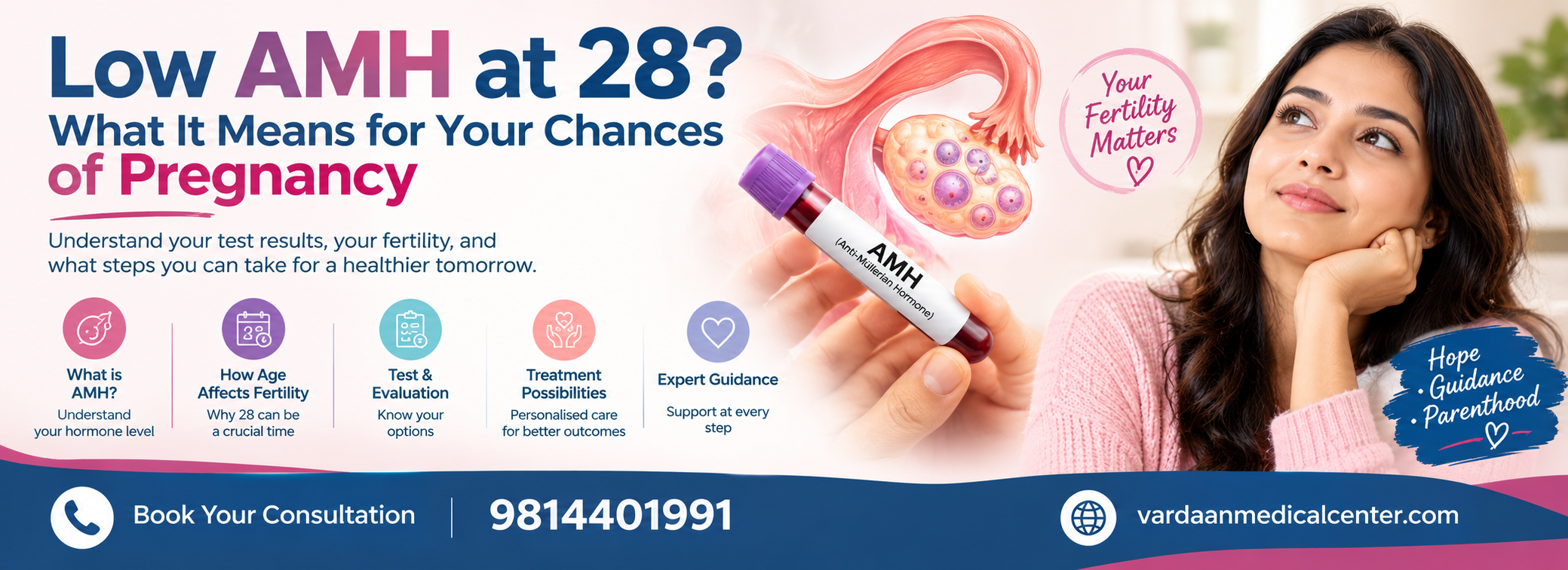
AMH (Anti-Müllerian Hormone) is produced by small follicles in your ovaries, which contain immature eggs. Generally, the more follicles you have, the higher your AMH level. This makes AMH an important marker of ovarian reserve, helping doctors estimate the number of eggs remaining in your ovaries.
What AMH Does Not Tell You
Egg Quality: AMH does not measure egg quality. Age plays a more significant role in egg quality, and younger women may have good-quality eggs even with lower AMH levels.
Natural Pregnancy Chances: Low AMH does not automatically mean you cannot conceive naturally. Women with low AMH who ovulate regularly may still conceive naturally.
Your Exact Fertility Timeline: AMH cannot predict exactly how long you will remain fertile. An IVF specialist in Punjab can interpret your AMH results alongside your age, antral follicle count (AFC), FSH levels, and overall reproductive health to provide a more complete fertility assessment.
Normal AMH Levels by Age
AMH naturally falls with age. Ranges differ slightly between labs, but these approximate values are a useful guide:
Age | Typical AMH (ng/mL) |
25 | around 3.0 |
28–30 | around 2.5 |
35 | around 1.5 |
40 | around 1.0 |
45 | around 0.5 or less |
As a rough rule, an AMH below 1.0 ng/mL is considered low, and below 0.5 ng/mL very low. So an AMH of 1.0 at 40 may be expected, while the same number at 28 is worth discussing with a fertility specialist. Always read your result against your own lab's reference range.
Why Is My AMH Low at 28?
There may not be a single clear reason for low AMH at 28. Common factors include:
Genetics and Family History: A family history of early menopause may indicate a naturally lower ovarian reserve.
Endometriosis: Ovarian cysts (endometriomas) or previous ovarian surgery may affect ovarian reserve.
Premature Ovarian Insufficiency (POI): A condition in which the ovaries lose their normal function before age 40.
Smoking: Smoking is associated with faster reproductive aging.
Medical Treatments and Conditions: Chemotherapy, radiation, and certain autoimmune conditions may affect ovarian function.
If you have low AMH at 28, consulting an infertility center in Punjab can help you understand your results and explore appropriate fertility assessment and treatment options. Low AMH does not automatically mean you cannot conceive naturally.
Treatment Options for Low AMH at Vardaan Medical Center
Every woman's report is different, so treatment is planned around your age, AMH, AFC scan, partner's semen analysis, and how long you've been trying. Options may include:
1. Timed Intercourse with Ovulation Tracking: Tracking ovulation helps identify your most fertile days, increasing your chances of natural conception.
If you ovulate regularly and your fallopian tubes are open, timed intercourse may be a good first step before exploring other fertility treatments.
2. Ovulation Induction with IUI: Ovulation induction uses mild fertility medicines to support egg development. Once the egg is ready, prepared sperm is placed directly into the uterus to improve the chances of fertilization.
If you're exploring IUI treatment in Punjab, a fertility specialist can assess your ovulation, sperm health, and overall reproductive health to determine whether this treatment is suitable for you.
3. IVF with a Personalized Protocol: In vitro fertilization (IVF) involves using fertility medicines to stimulate the ovaries and retrieve mature eggs for fertilization in a laboratory. For women with low AMH, the treatment protocol is tailored to their ovarian reserve to maximize the chances of retrieving suitable eggs.
An IVF center in Punjab can help you understand your treatment options. Low AMH may mean fewer eggs are retrieved, but it does not automatically mean IVF cannot succeed.
4. ICSI (Intracytoplasmic Sperm Injection): ICSI is an advanced fertility technique in which a single sperm is injected directly into a mature egg in a laboratory. It is commonly recommended for male-factor infertility or previous fertilization problems.
ICSI may be considered during IVF for women with low AMH, depending on individual circumstances. However, it does not increase the number of eggs available or guarantee successful fertilization.
5. Egg Freezing: Egg freezing involves retrieving mature eggs from your ovaries and preserving them for future use. At 28, egg quality is generally better than at an older age, making it worth considering if you're not ready for pregnancy yet.
However, low AMH may mean fewer eggs are retrieved in one cycle. A fertility specialist can assess your ovarian reserve and help you understand whether egg freezing is a suitable option.
6. Donor Egg IVF: Donor egg IVF involves fertilizing eggs from a donor with sperm in a laboratory and transferring the resulting embryo into your uterus. It may be recommended for women with very low AMH or premature ovarian insufficiency (POI).
With this treatment, you can carry the pregnancy and give birth to your baby. A fertility specialist can help determine whether donor egg IVF is suitable for your circumstances.
Can Lifestyle Changes Help?
No diet or supplement can create new eggs or "fix" AMH. But healthy habits support the quality of the eggs you have and improve your overall chances:
Quit smoking and limit alcohol.
Eat a balanced diet with fresh vegetables, fruits, whole grains, dal, nuts, and good fats.
Keep a healthy weight, since both underweight and overweight can affect ovulation.
Stay active with regular, moderate exercise like walking or yoga.
Manage stress and sleep well. It won't change AMH, but it helps you cope with the journey.
Ask before taking supplements. Options like vitamin D or CoQ10 should be taken only on your doctor's advice.
When Should You See a Fertility Specialist?
Book a consultation soon if:
Your AMH is below 1.0 ng/mL, especially if you're under 35.
You've been trying to conceive for 6 months or more without success.
Your periods are irregular, very light, or have stopped.
You have endometriosis, PCOS, or a family history of early menopause.
You want children later and are considering egg freezing.
A low AMH report is not the end of your story; it's the start of a plan. At Vardaan Medical Center, our fertility experts review your reports, explain your options in simple words, and develop a personalized treatment plan.
As a trusted fertility clinic in Punjab, we aim to help you understand your fertility and take informed steps towards building your family. Book your consultation today and take the first step towards your fertility journey.
Frequently Asked Questions
Can AMH levels increase naturally?
AMH can vary a little between tests, but no treatment reliably raises your egg reserve. The focus is on making the best use of the eggs you have.
Does low AMH mean early menopause?
Not necessarily. Low AMH suggests a smaller reserve, but it can't predict exactly when menopause will happen.
Is IVF successful with low AMH?
It can be. You may get fewer eggs per cycle, but younger women with low AMH often have good-quality eggs, which helps.
Should I freeze my eggs if my AMH is low?
If pregnancy isn't in your plans soon, egg freezing at a younger age is worth discussing with your doctor.