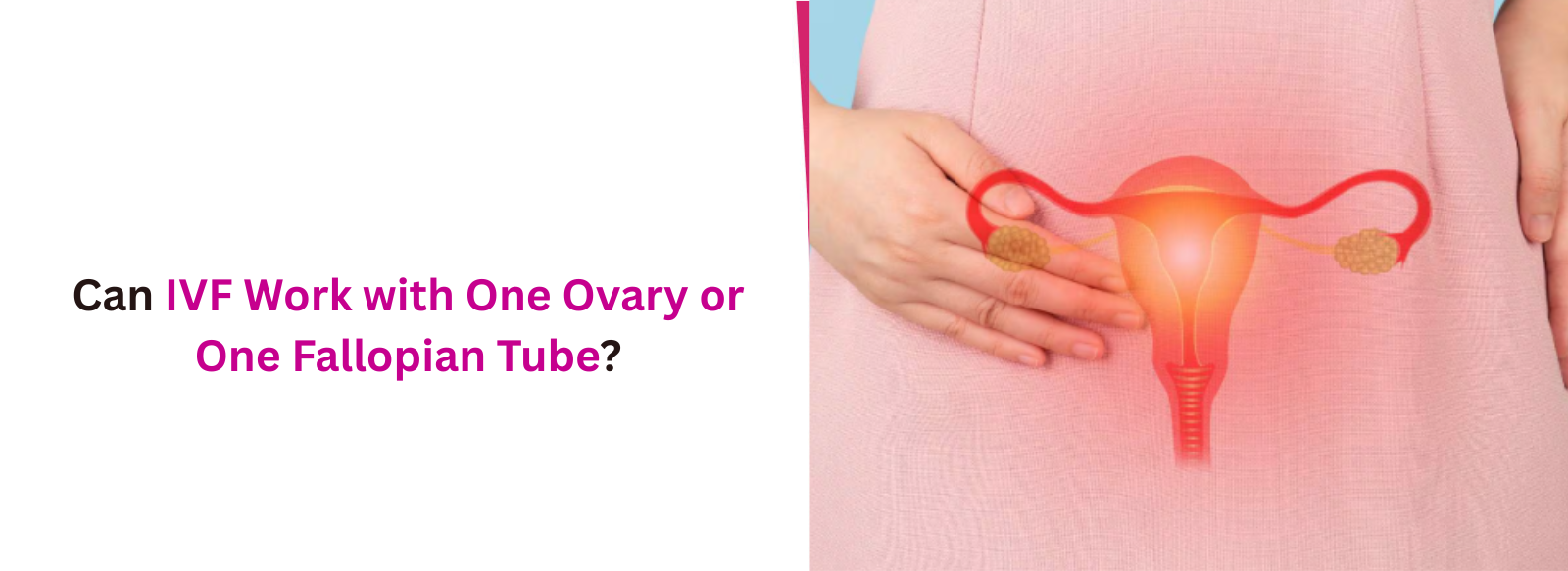

Can IVF work with one ovary or one fallopian tube? Yes. Pregnancy is possible as long as one ovary produces healthy eggs and the uterus is healthy. IVF does not rely on fallopian tubes because fertilization happens outside the body. Success depends more on age, egg quality, ovarian reserve, and uterine health than having two ovaries or tubes.
Can You Get Pregnant with One Ovary Naturally?
Yes, a woman can get pregnant with one ovary. As long as the ovary is healthy and ovulation occurs, natural pregnancy is possible. IVF can further improve chances if needed. Many women ask, “Can I get pregnant with one ovary?” The answer is yes, as long as ovulation is regular and the ovary is healthy.
How does IVF Work?
In natural conception, the process relies heavily on timing and anatomy. The ovary releases an egg, the fallopian tube picks it up, fertilization happens inside the tube, and then the embryo travels to the uterus.
IVF follows a completely different route.
In IVF, eggs are retrieved directly from the ovaries using a guided procedure. Fertilization happens in a laboratory, not inside the body. Once an embryo develops, it is transferred straight into the uterus. The fallopian tubes are not part of this process at all.
This is why IVF is often recommended for women with tubal damage or absence. As long as there is a functioning ovary producing eggs and a uterus capable of carrying a pregnancy, IVF remains an option.
It’s also worth mentioning that ovaries do not work in isolation. Hormonal signals from the brain regulate them, and the body often adapts surprisingly well when one ovary is missing.
Can IVF Work with One Ovary?
Having one ovary is not rare. It can happen due to surgery for ovarian cysts, torsion, endometriosis, ectopic pregnancy complications, or even from birth. In some cases, the ovary is removed to protect overall health, not because fertility was already compromised.
What many women don’t know is that the remaining ovary often compensates. Hormonal balance usually adjusts within a few months, and ovulation continues regularly in many cases. This means egg production does not necessarily drop by half, even though the ovary count does.
That said, the total ovarian reserve (the number of eggs available over time) can be lower. But IVF is not about how many eggs you have overall. It’s about how your ovaries respond to stimulation at a given point.
And that distinction matters.
IVF Success Rates with One Ovary
IVF success is influenced more by egg quality than egg quantity. Pregnancy with one ovary is possible and may produce fewer eggs during stimulation, but fewer eggs does not automatically mean lower success.
If even one good-quality embryo forms, pregnancy is possible.
Clinical observations have shown that many women with one ovary achieve pregnancy rates similar to women with two ovaries, especially when they are younger and have a reasonable ovarian reserve. IVF protocols can also be adjusted. Higher stimulation doses or modified cycles are commonly used.
Sometimes the response is slower. Sometimes fewer eggs are retrieved. But outcomes are not nearly as discouraging as people assume at first glance.
Can IVF Work with One Fallopian Tube?
Fallopian tubes play a crucial role in natural pregnancy. They capture the egg after ovulation, provide the site for fertilization, and transport the embryo to the uterus. Damage to even one tube can reduce natural fertility, especially if ovulation does not consistently happen on the same side as the healthy tube.
This unpredictability is often frustrating for couples trying naturally.
However, this entire step is bypassed in IVF.
IVF with One (or No) Fallopian Tube
IVF does not require fallopian tubes. Not one. Not two.
Eggs are collected directly from the ovary, fertilized outside the body, and placed into the uterus. Women with one fallopian tube, blocked tubes, or even both tubes surgically removed can and do conceive through IVF.
In fact, IVF is often the preferred treatment for severe tubal damage because it avoids the risk of ectopic pregnancy, which can occur when damaged tubes are still present.
So if your concern is purely about having only one fallopian tube, IVF largely removes that limitation from the equation.
IVF with One Ovary AND One Fallopian Tube
This is where anxiety usually peaks. Having both limitations together can feel overwhelming, and many women assume their chances are very low.
But again, IVF changes the rules.
If you have:
At least one functioning ovary that can produce eggs
A healthy uterus with no major implantation issues
IVF is still medically possible.
The presence or absence of a fallopian tube does not affect IVF success. What matters more is how the ovary responds to stimulation and whether viable embryos can be created.
Of course, this combination does require careful evaluation. Hormonal testing, ultrasound monitoring, and individualized protocols become especially important. Some cycles may need adjustments, and in certain cases, multiple cycles may be advised.
Still, the situation is far from hopeless, even if it feels that way initially.
Factors That Affect IVF Success in These Cases
This is where things become more personal. No two IVF journeys are identical, especially when reproductive anatomy differs.
01. Age
Age remains one of the strongest predictors of IVF success. Egg quality naturally declines over time, regardless of the number of ovaries present. Younger women with one ovary often do better than older women with two.
02. Ovarian Reserve (AMH and AFC)
Tests like AMH levels and antral follicle count give insight into how the ovary may respond to stimulation. A single ovary with a good reserve can outperform two ovaries with poor reserve.
03. Egg Quality
Quality determines embryo potential. Even a small number of high-quality eggs can lead to successful pregnancy.
04. Uterine Health
The uterus must be receptive. Conditions like fibroids, adhesions, or thin endometrium can affect implantation, independent of ovary or tube status.
05. Underlying Conditions
Endometriosis, PCOS, autoimmune disorders, or previous pelvic infections can influence IVF outcomes and must be managed alongside treatment.
06. Customized IVF Protocols
Standard protocols don’t work for everyone. Women with one ovary often benefit from tailored stimulation plans designed to maximize response without overburdening the body.
Sometimes results improve only after tweaking the approach. That’s fairly common, actually.
When Should You Consider IVF?
Timing matters more than most people expect.
If you have one ovary or one fallopian tube and have been trying naturally for over a year without success, an evaluation is sensible. In women over 35, this window shortens to about six months.
Earlier IVF consideration is often advised if:
Ovarian reserve is low
There is a history of pelvic surgery
Tubal damage is known
Endometriosis is present
Age is advancing
Waiting too long can reduce options, especially if ovarian reserve is already borderline. IVF does not guarantee success, but delaying assessment can quietly reduce probabilities over time.
Emotional and Psychological Considerations
This part rarely gets enough attention.
Being told that part of your reproductive system is missing can trigger grief, anger, or guilt. Even when logically you know it’s not your fault. IVF itself can feel intimidating, and anatomical limitations may intensify self-doubt.
It’s important to understand that fertility struggles are not a reflection of worth or femininity. Bodies vary. Medicine adapts.
Support (from partners, counselors, or fertility specialists) can make a real difference. Many women find that once they understand the science behind IVF, some of the fear loses its grip. Not all of it, but enough to move forward with clarity.
And sometimes clarity is all you need to take the next step.
Conclusion
Yes, IVF can work with one ovary or one fallopian tube. In many cases, it works remarkably well.
The success of IVF is not dictated by symmetry or textbook anatomy. It depends on egg quality, uterine health, age, and individualized treatment planning. While having fewer reproductive structures can influence the approach, it does not automatically close the door to pregnancy.
If you are navigating this situation, the most important step is not self-diagnosis or comparison. It’s a proper medical evaluation. With the right guidance and realistic expectations, IVF remains a viable and hopeful path for many women with one ovary or one fallopian tube.
Sometimes the body surprises us. And sometimes medicine helps it do exactly that.
Visit Vardaan Hospital for IVF Treatment
If you’re exploring IVF treatment in Amritsar and Jalandhar, choosing the right fertility center can make all the difference. Vardaan IVF Center offers advanced IVF care with a patient-first approach, combining experienced fertility specialists, modern lab technology, and personalized treatment plans. With trusted centers in both Amritsar and IVF clinics in Jalandhar, Vardaan IVF Center supports couples through every stage of their fertility journey. Clearly, ethically, and compassionately. Book a consultation now.