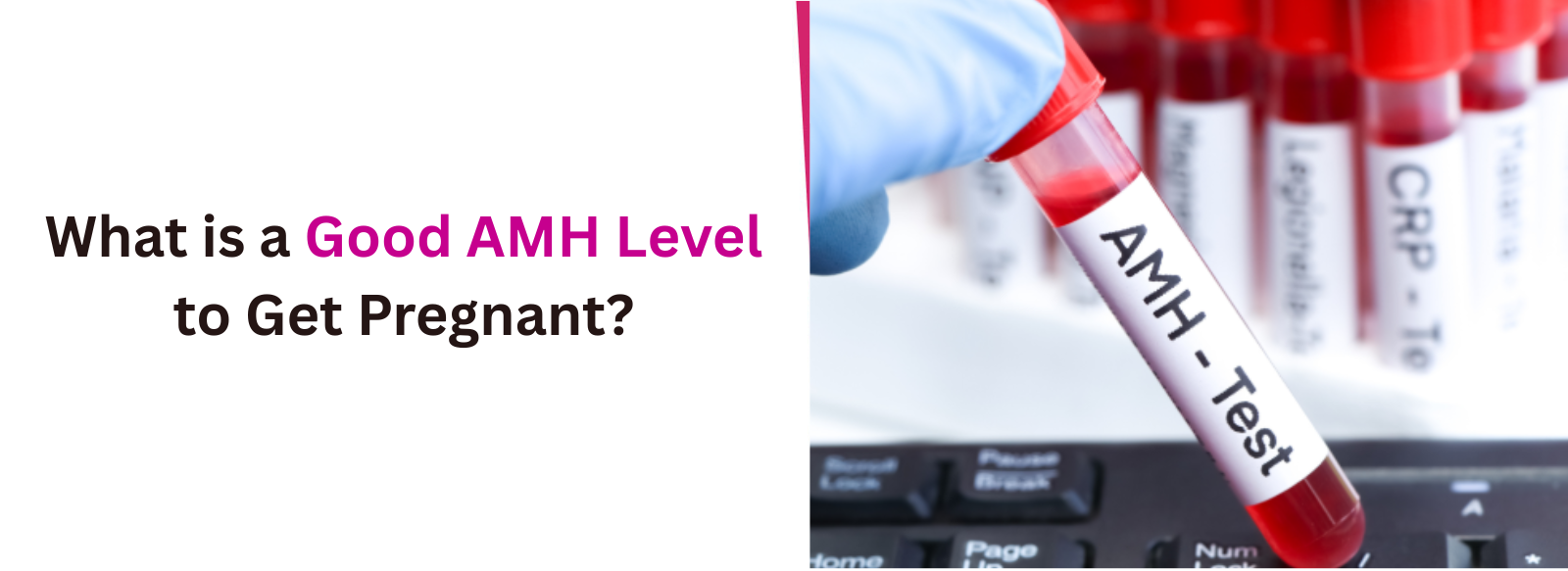
If you’re here, you’re probably holding your AMH report in your hand. Staring at the number and wondering, “Is this good? Can I still get pregnant?”
We understand how emotional this moment can feel. Let’s sit with this calmly and go through it together.
The short answer?
A “good” AMH level for pregnancy is usually between 1.0 and 3.5 ng/mL. But that number alone does not decide whether you will conceive. Your age, ovulation pattern, egg quality, and your partner’s sperm health matter just as much. Sometimes even more.
Let’s break this down in a simple, reassuring way.
What Is AMH and Why Did We Test It?
AMH stands for Anti-Müllerian Hormone. It is produced by the small follicles (tiny sacs) in your ovaries that contain immature eggs.
When we test AMH, we are estimating your ovarian reserve, which means:
How many eggs may be left in your ovaries
How your ovaries might respond to fertility treatment
Whether we need to plan sooner rather than later
What AMH does not tell us:
It does not measure egg quality
It does not confirm whether you can or cannot get pregnant
It does not predict natural conception perfectly
Think of AMH as a quantity indicator, not a quality report card.
What Is Considered a Good AMH Level?
In general, we interpret AMH like this:
Above 3.5 ng/mL – High
1.0 to 3.5 ng/mL – Normal / Reassuring
0.5 to 1.0 ng/mL – Low normal
Below 0.5 ng/mL – Low
For most women trying to conceive naturally, an AMH between 1.0 and 3.5 ng/mL is considered good.
But here’s something very important: A 28-year-old with an AMH of 0.8 is very different from a 40-year-old with 0.8. That’s why we never read this number in isolation. We read you, not just your report.
AMH Levels by Age: Why Age Matters More Than the Number
AMH naturally declines with age. That is normal biology.
Here’s a rough idea of average AMH ranges:
Age Range | AMH Level Range |
Under 30 years |
|
30–34 years |
|
35–39 years |
|
40+ years |
|
If your AMH fits your age group, that is reassuring.
Even if it is slightly lower, it does not mean pregnancy is impossible. It simply means we may need to plan wisely.
Can You Get Pregnant With Low AMH?
Yes. Absolutely yes. We see many women with low AMH conceive naturally. Low AMH means:
Fewer eggs remaining
Shorter reproductive window
It does not mean:
No eggs
No ovulation
No chance of pregnancy
If you are younger (under 35), even a low AMH can still mean good egg quality. Egg quality is more closely linked to age than AMH. So if your report says 0.7 or 0.8, don’t panic. Instead, think of it as information that helps us act early and smartly.
What If Your AMH Is Very High?
If your AMH is above 4.0 or 5.0 ng/mL, we often evaluate for Polycystic Ovary Syndrome (PCOS). In PCOS:
The ovaries contain many small follicles
AMH can appear high
Ovulation may be irregular
Here’s the reassuring part: Women with PCOS often have a good egg reserve. The issue is ovulation timing, not egg availability.
With ovulation tracking, medication if needed, and cycle regulation, pregnancy is very possible. So high AMH is not “better” than normal. It just tells us something different about how your ovaries are functioning.
Does AMH Predict Natural Pregnancy?
This is one of the most common questions we hear. AMH is very helpful in predicting how you might respond to IVF stimulation. It is less powerful in predicting natural conception. For natural pregnancy, what matters most:
Are you ovulating regularly?
Are your fallopian tubes open?
Is sperm quality normal?
Are you timing intercourse correctly?
How old are you?
A woman with AMH 0.9 who ovulates monthly may conceive faster than someone with AMH 4.5 who doesn’t ovulate at all. So again, the number is part of the picture.
AMH vs Other Fertility Tests: What Should You Focus On?
When we evaluate fertility, we look at multiple factors together.
FSH (Follicle Stimulating Hormone): High FSH may indicate reduced ovarian reserve.
Antral Follicle Count (AFC): Seen on ultrasound; counts visible small follicles.
Ovulation pattern: Regular 26–32 day cycles usually suggest ovulation.
Thyroid levels: Thyroid imbalance can affect conception.
Semen analysis: Fertility is a couple’s journey, not only yours.
If your AMH worries you, we simply balance it with these other parameters before making any decisions.
When Should You Get an AMH Test?
We usually recommend AMH testing if:
You have been trying to conceive for 6–12 months
You are above 30 and planning pregnancy
You have irregular periods
You have PCOS
You are considering egg freezing
There is a family history of early menopause
The test can be done on any day of your cycle, which makes it convenient.
If AMH Is Low, What Should You Do Next?
First of all, take a breath. Low AMH is not an emergency. It is a signal. Here’s how we approach it together:
Do not delay trying
Track ovulation carefully
Maintain healthy body weight
Check thyroid and vitamin D
Avoid smoking
Seek evaluation earlier rather than later
If you are under 35, we may suggest trying naturally for a few months with proper timing. If you are above 35 with low AMH, we may suggest earlier intervention, such as ovulation induction or IVF, depending on your overall picture. The key is personalized planning, not fear-based decisions.
How to Improve Your Chances of Pregnancy (Regardless of AMH)
Whether your AMH is high, low, or normal. These steps improve outcomes:
Understand Your Ovulation Window: Use ovulation kits or follicular scans if needed.
Maintain a Healthy BMI: Both underweight and obesity can affect ovulation.
Eat Fertility-Supportive Foods: Balanced protein, healthy fats, leafy greens, and iron-rich foods.
Manage Stress: Chronic stress affects hormonal balance.
Don’t Ignore Irregular Cycles: Irregular periods are treatable in most cases.
Evaluate Your Partner Early: Male factor infertility accounts for nearly 40–50% of cases.
Is AMH Important for IVF?
Yes, AMH is especially useful when planning IVF.
It helps us estimate:
How many eggs we might retrieve
What stimulation dose to use
Risk of over-response (especially in PCOS)
However, even in IVF:
Egg quality depends mainly on age
Lower AMH may mean fewer eggs, not zero embryos
Many women with low AMH still achieve successful pregnancies
We tailor treatment based on your specific profile.
Emotional Side of AMH Results
We see this often: A woman walks in confidently. She sees a “low” number. Suddenly, she feels her timeline shrinking. Please remember:
AMH is a planning tool
It is not a fertility verdict
It does not define your womanhood
It does not eliminate hope
We prefer you come in with questions rather than silent anxiety.
When Should You See a Fertility Specialist?
Consider consulting if:
Under 35 and trying for more than 1 year
35 or older and trying for more than 6 months
AMH is below 1.0
You have irregular cycles
You’ve had recurrent miscarriages
Early consultation doesn’t mean jumping to IVF. It means understanding your options.
Final Takeaway
A good AMH level is one that:
Matches your age
Allows regular ovulation
Fits into your pregnancy timeline
For most women, 1.0–3.5 ng/mL is reassuring. But even outside that range, pregnancy is often still possible. What matters more than the number:
Your age
Egg quality
Ovulation
Sperm health
Timely action
If you are worried about your AMH report, let’s look at it together. We we treat people. And your story is more important than a single lab value. You are not late. You are not broken. You simply need the right guidance. And that’s something we can work on. Together.
Visit Vardaan Hospital for Pregnancy Issues
If you’re looking for compassionate, evidence-based fertility care, Vardaan IVF Hospital in Jalandhar brings together experienced fertility experts in Jalandhar and Amritsar who focus on personalized treatment. From detailed fertility evaluation to advanced IVF care, we guide you step by step with clarity and honesty. Our goal is simple: help you understand your options, protect your timeline, and move confidently toward parenthood with the right medical support. Book your appointment now.